Property & Construction Summit Focuses on Skills and Technology
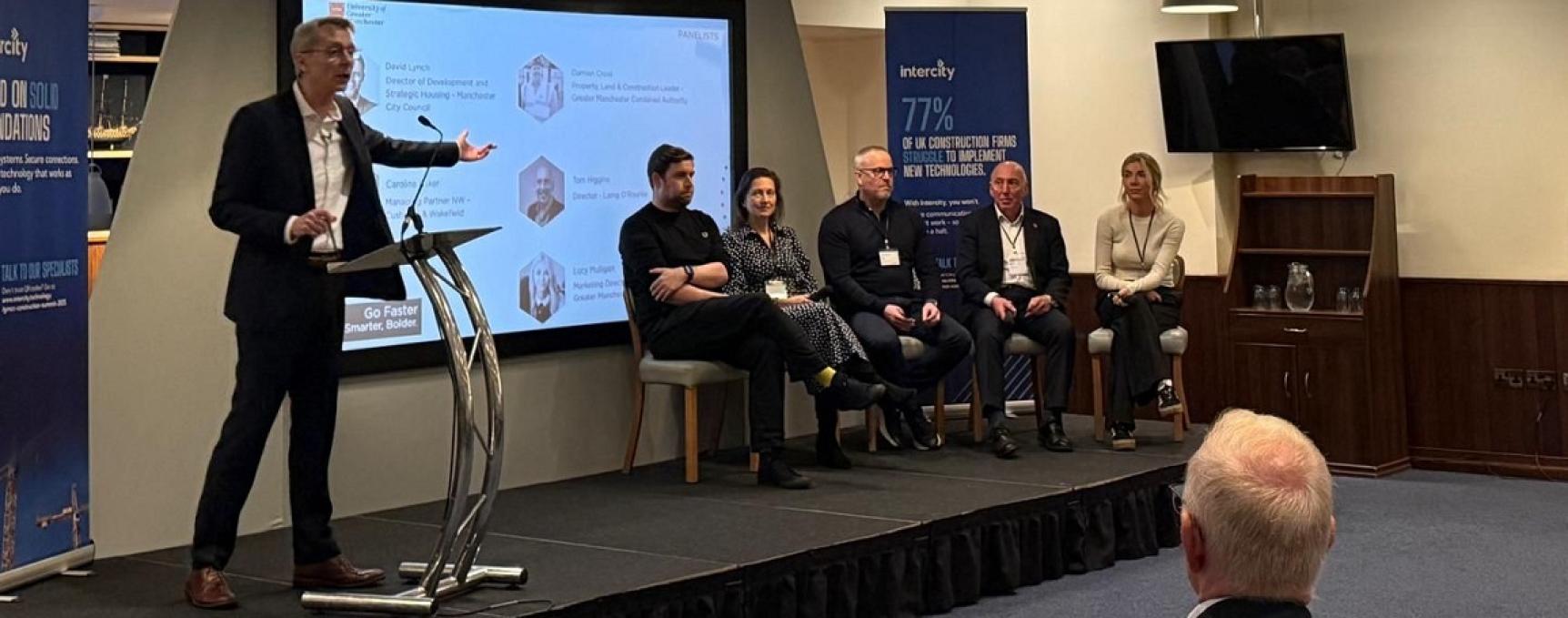
There was a packed agenda at this year’s Property & Construction Summit, which took place at the Etihad Stadium in November. The flagship event brought together industry leaders and key stakeholders to debate how the sector can lead the way in delivering sustainable and meaningful change.
PANEL ONE: GM Region Vision 2050
The Summit began with a panel discussion of the key development milestones of the last 25 years and what the region would look and feel like in the next 25 years. The panel included speakers from Greater Manchester Chamber, Manchester City Council, Greater Manchester Combined Authority, Cushman & Wakefield and Laing O’Rourke North.
Subrahmaniam Krishnan-Harihara, Director of Business Policy and Research at the Chamber, opened the debate by giving an overview of the economic situation and the construction pipeline. Despite the latest data showing the construction sector was in the worst downturn it had seen in over five years, he said Greater Manchester was bucking the national trend.
He added: “Here in Greater Manchester, something extraordinary seems to be happening. When we published our first construction pipeline back in 2013, we identified £15.6 billion of work over five years. Fast forward to today and the data shows there is a verified pipeline of nearly £40 billion for the five years from 2025 to 2029. An estimated £40 billion over five years, compared with £15 billion for 2013 to 2017. We've nearly tripled our ambitions for the sector despite the sector facing a contraction nationally.
“This year alone, we're estimating £11 billion of construction activity. Next year, another £11 billion. Greater Manchester is clearly countercyclical. We're not waiting for perfect conditions. We're creating them. These are estimates. Speculative projects are included. The actual figures may be lower. But even if we deliver 70%-80% of the estimated pipeline, we're still looking at unprecedented growth.”
Subrahmaniam highlighted the fact that housing used to be about 40% of the pipeline but is now over 60%. With most new housing being in high-rise apartments put up as part of complex urban regeneration, he said there would be a robust repairs and refurbishment pipeline over the next 25 years. But he warned the country was only building between 50% and 60% of the housing that was needed, with current forecasts suggesting the target of 1.5 million homes would be missed by half a million.
Retrofit and Net Zero
Subrahmaniam said a second defining aspect of the next 25 years would be retrofit because of the huge number of buildings in Greater Manchester that needed to be retrofitted.
“The harsh reality is that Manchester's built environment is responsible for a significant chunk of our direct emissions,” he explained. “We have thousands of homes and commercial buildings that need retrofitting to hit our 2038 zero carbon target. But retrofit is lagging even further behind than new build. The pipeline for this work could be enormous but only if there is investment, planning, and above all, skills.
Technology adoption
He predicted that the third defining force of the next 25 years would be technology, particularly digital technology.
“The construction site of 2050 could be unrecognisable relative to what it is today,” he said. “It is feasible that a site manager wearing an augmented reality headset, will be overseeing a very diverse team of workers. Those workers could include a lot more women, but it could include collaborative robots. There could be autonomous systems doing the dirty, dangerous work.”
He said the adoption of technology would deliver a solution to the skills crisis and a potential boost to productivity. But people would still be important with the Construction Industry Training Board (CITB) warning that 251,500 additional needed by 2028.
As well as speeches from leading industry figures, there were workshops discussing the key issues affecting the Property & Construction sector. The workshops featured representatives from the public and private sectors, including construction companies, local authorities and colleges. Topics discussed included the skills needed by the sector, the adoption of technology and growing Greater Manchester’s town centres.
WORKSHOP ONE – Unlocking the Skills Puzzle
The construction pipeline was said to be ‘absolutely crucial’. While everyone believed they could do some good and change lives through the creation of careers in the sector, they said they needed to know the work was there for a reasonable period to take the risk of employing someone. That had been difficult in recent years, creating an employment ecosystem that was very short-term focused and insecure.
Data from the Local Skills Improvement Plan (LSIP) was felt to be a useful alternative to the construction pipeline (as well as being useful in its own right) because it provided a real-time, region-specific gauge of exactly what the demand for labour was. Delegates said Greater Manchester Chamber should play a central role in the regular dissemination of this information.
While a shared apprenticeship model was popular among participants, it was pointed out that one had been trialled unsuccessfully recently, so there was some caution around it.
Getting into schools was highlighted as one of the most crucial tools for engaging with tomorrow’s workforce, as was being active on the kinds of social media platforms that young people already use. It was agreed the sector should be aiming to influence young people early on and ensure that both ‘blue’ and ‘white’ collar roles were visible.
The importance of role-modelling was highlighted with an emphasis on showing inspiring roles, particularly those delivered by people who looked and sounded like the target audiences. It was felt that many young people from diverse backgrounds would not consider careers in property, regeneration and design because they believe they were not for them. Conversely, contracting and trade roles were still being framed as exclusively for young people who did not enjoy the education system, and this had to change.
Despite issues around the perception of the sector, there was said to be a demand for trades and skills courses. Wigan and Leigh College, for example, was always oversubscribed for construction courses and could easily offer more. It was suggested the College and other FE institutions could act like recruitment companies for the sector, but there was a concern that that the sector was wasteful with the talent that it did receive.
While the image of the sector was described as broken and unfair, it was said those in the sector were not helping by focusing on only communicating with people at the point of immediate need and leaving the responsibility for framing and promoting the sector to young people. This meant the sector was at the mercy of how knowledgeable and sympathetic these influential people were towards the sector.
SMEs were said to be in an awful position with apprentices as they also had to also take on a pastoral role for some young people when placements ended and new roles could not be found. The sector was unique in its composition, with a heavy weighting towards SMEs, but little thought was given to making the training/apprenticeship system straightforward for these smaller businesses to navigate a complex qualification and regulatory landscape in order for them to make finding talent easier.
Stewart Grant, Head of the Chamber’s Property & Construction Group, commented: “One of the most interesting points for me, and something I’m ashamed to have not considered before, is the amount of pastoral work that can often go on when on-boarding young talent in trades. They’re often from complex backgrounds, navigating the world of work (and all of its responsibilities) for the first time, and when apprenticeships fall because projects end or there isn’t work it can often fall to an overworked, unskilled member of staff in the host organisation to try and find them alternative employment. This is difficult for all parties, and something I was totally blind to. It really feels like there is a chasm between the large and small firms in our market, and some kind of knowledge transfer or policy intervention that could level the playing field would be welcome.
“The role of the CITB was called in to question. The levy doesn’t appear to be working, it certainly isn’t popular, and there is a growing resentment about the CITB’s role. Rightly or wrongly, it’s felt that it isn’t doing enough on skills, and that it should be leading the charge on promoting the sector and its brand – and isn’t.”
WORKSHOP TWO – Shouting About Our Tech
This session examined how construction was perceived by the public and showcased live examples of technology and AI in practice. Despite visible progress, negative perceptions of the sector remained with 52% of the public associating construction with being “dirty” and only 6% viewing it as “high tech.”
Demonstrations during the workshop highlighted digital delivery, AI-enabled workflows and the role of academic partnerships in helping firms introduce new technology.
Only a small proportion of attendees (10%) regularly used AI, with take-up especially low among SMEs, who viewed AI as complicated and costly. Attendees suggested that targeted support would help SMEs trial and embed technology.
Although the desire to adopt new technology was strong and most participants did not cite major cultural resistance, barriers included:
• The route to adopt for tools, sequence, and costs was unclear for many organisations, particularly smaller firms.
• Legacy systems and the investment required to replace or integrate them were frequently mentioned as practical blockers.
Participants felt the sector should communicate its technological capabilities more loudly to local and central government, linking innovation to productivity, safety and delivery outcomes. Skills shortages and current staffing levels were cited as constraints on SMEs adoption, reinforcing the need to make technological shifts as straightforward as possible.
There was strong interest in peer learning and practical demonstrations. A clear majority asked the Chamber to host more “Technology Show & Tell” presentations, with real projects, short demonstrations and open Q&As. Attendees also welcomed signposting to academic collaboration routes that can help de-risk early adoption.
Overall, the workshop attendees were optimistic about technology’s impact and relevance, pragmatic about the effort required to move from legacy tools, and they had a clear appetite for simple, affordable adoption pathways, especially for SMEs.
WORKSHOP THREE – Growing Our GM Towns
The last 10 years has seen a reinvention of our town centres, fuelled by changes in behaviour post pandemic and a real commitment to public/private sector partnership and collaboration. Nowhere is this more visible, than Greater Manchester where some extraordinary projects are repurposing and revitalising tired and old assets.
The workshop explored the key challenges and opportunities of creating places that work for local communities and ensure long term sustainable development.
Participants said delivery must be real and there needed to be more focus on delivery in the early stages of masterplan development. Identity was felt to be key, so there could be no clone towns. It was said an “Altrincham market” did not work in every town as each of Greater Manchester towns has its own identity.
Social infrastructure was described as the glue that held towns together. Partnership was highlighted as the path forward as it would always be the route to success.
Public and private sector leaders discussed how Greater Manchester’s towns can attract investment, strengthen communities by reducing inequalities and deliver equitable, sustainable growth. The panel emphasised practical learning from current projects, the importance of collaboration, and the need for long-term commitment to residents.
A central theme was the shift from traditional high-street models towards flexible, multi-use town centres. The transformation of Oldham’s Spindles Centre was highlighted as an example of how ageing assets can be repurposed to meet contemporary needs. Its redevelopment combines modern cultural spaces, such as an updated cinema and the restored Egyptian Rooms, with a new library designed to attract wider community use.
Panellists noted that regeneration increasingly focuses on repurposing and refurbishing rather than solely new construction. This approach helps tackle vacancy, reduce environmental impact and protect heritage value while still enabling fresh activity.
Beyond buildings, speakers emphasised the importance of placemaking through public spaces - parks, cafés, local festivals and events - which contribute just as much as physical infrastructure to a town’s identity and economic vitality.
Reducing Inequalities Through Connected, People-Focused Infrastructure
The discussion also centred on how regeneration can reduce inequalities across the city region. Oldham’s push to connect rural areas and the town centre with improved Metrolink links was offered as a model of transport-led social infrastructure.
With boroughs such as Wigan comprising up to 14 distinct towns, panellists stressed the need for strategic alignment across neighbouring places, ensuring towns collaborate rather than compete for the same funding streams. Avoiding duplication and securing genuine stakeholder support were identified as essential for making investment stretch further.
Building Confidence Through Delivery and Collaboration
The panel agreed that community confidence grows when development moves from planning to delivery quickly - ideally with construction starting within 12 months of approval. They emphasised that clarity from government departments (particularly around funding timelines and legal frameworks) is crucial for maintaining momentum.
Examples from across Greater Manchester, such as the creation of SME business hubs within refurbished buildings and the "Fettlers" initiative (the regeneration of the Galleries shopping centre in Wigan), supported by PR and communications teams, showed how council–contractor collaboration can revive declining areas and attract new economic activity.
Speakers were clear that regeneration requires honest conversations, shared vision, and transparent communication with residents about long-term aims and potential trade-offs.
GMCC’s Role in Supporting Regeneration
To close, panellists highlighted how GMCC can play a vital role in being a catalyst for change within the property and construction sector in Greater Manchester by:
• Convening local authorities, businesses and community voices,
• Helping towns articulate long-term visions with clear “why and how” narratives,
• Supporting employers in implementing net-zero strategies,
• Ensuring Greater Manchester speaks with a collective voice when securing national funding.
• Voicing member opinions
PANEL TWO – Dialling Up The Environment
The Summit ended with a panel discussion about the environment. The panel included speakers from Casey, AEW Architects, Renaissance Engineers and Muse Places.
Manchester’s new Five-Year Climate Change Framework (2025–2030), is set to re-shape the city's journey toward zero carbon by 2038. With Manchester currently off-track on its decarbonisation journey, this workshop was a vital platform to explore how the Property & Construction sector, which is responsible for the majority of the city’s direct emissions, can lead the charge in accelerating progress.
The panel debated the crucial role of climate adaptation, fair financing models for a ‘just transition,’ and the opportunities for the Property & Construction industry to thrive in a low-carbon economy.
Sustainability and Climate Resilience
The discussion explored how far sustainability commitments are being delivered at local level, including HGVs for electric vehicles. The panel raised concerns about emerging climate issues such as building overheating, the durability of materials under extreme temperatures, and whether current standards are fit for the next 50 years. There were also questions about whether net zero policies are being filtered down to employers.
The Property & Construction Summit was just the start of a bigger conversation about driving economic growth in the sector and the city region which will continue into 2026 and beyond. You can play your part by joining one of our Property & Construction events.