Survey Reveals Impact of Budget and Global Challenges
The results of Greater Manchester Chamber’s Quarterly Economic Survey and the Growth Company’s monthly Situation Report were revealed at a Quarterly Economic Review yesterday (16th December).
The joint briefing came against a background of gloomy business news with the economy shrinking unexpectedly by 0.1% in October, partly due to the cyber-attack on Jaguar Land Rover hitting UK car production and pre-Budget uncertainty affecting both consumer and business spending.
Subrahmaniam Krishnan-Harihara, Director of Business Policy and Research at Greater Manchester Chamber of Commerce, and Rupert Greenhalgh, Head of Business Intelligence at The Growth Company, gave an overview of the results of their respective surveys.
Rupert said: “Over the past decade, Greater Manchester has emerged as one of the UK’s most dynamic and resilient city regions. As we approach 2026, the story of GM is one of transformation - driven by innovation, investment, and a relentless focus on productivity and business growth.
“The Situation Report has given us an unparalleled insight into the region’s businesses. Confidence remains relatively robust though rising costs continue to be the most significant challenge, cited by 30 per cent of respondents.”
The Situation Report showed recruitment activity had fallen by three percentage points, with 22% of businesses currently hiring, particularly among SMEs and in sectors such as BFPS, Construction, Education, Green Tech, Manufacturing and Retail. Yet, workforce skill gaps persist, especially in specialist technical and advanced IT skills, underscoring the need for ongoing investment in talent and training.
Business Confidence
The Quarterly Economic Survey (QES) revealed manufacturing confidence had gone down with more businesses reporting a decline than an uplift, reflected by national data which showed the sector had been struggling for some time. The QES showed confidence had also declined in terms of services and business sentiment was low. Spending on credit cards had been low, which has had a big impact as the UK has a huge reliance on consumer spending. Businesses in the construction sector were more confident because delayed public sector projects were coming through but there was concern about the future pipeline.
Subrahmaniam said: “Business confidence for services has gone up, but manufacturing is an area of concern and one to watch.”
Comparing the figures before and after the Budget in November, he said there had been a reduction in business confidence and that the Budget “had definitely got a thumbs down from the business community.” He added that businesses were struggling to absorb rising costs such as the increases in tax and National Living Wage and added that the Budget had “definitely contributed to a decline in business confidence.”
Subrahmaniam explained that, while the QES showed the services sector was performing better, it did not invest as much as manufacturing and confidence was down as businesses were facing higher costs and more competition.
Northern Power
Subrahmaniam described Greater Manchester as the “power in the Northern Powerhouse” pointing out that when Greater Manchester struggled, the North West struggled. With 40% of North West employment in Greater Manchester and Greater Manchester making up 2-3% of the UK economy. He pointed out that the growth was mainly coming from B2B services not B2C services. He highlighted that working from home continued to have an impact on city centre businesses due to their reliance on workers coming into Manchester.
Global Disruption
Turning to international trade, Subrahmaniam said export had experienced three years of volatility in international trade with continual ups and downs. He warned that the complication of increased paperwork and the cost of shipping meant that some SMEs had given up exporting completely.
Top Concerns
The QES showed the impact of inflation was the number one concern in Greater Manchester, but Subrahmaniam warned that it was unlikely to go down quickly due to the number of businesses reporting that they were putting up their prices. Other issues raised by businesses included the uncertainty caused by the Budget and concerns about government policy.
Subrahmaniam said that, despite all the challenges revealed by the QES, there was some good news in the survey as the GM Index had increased from 13.3 to 14.9, with a general feeling that “things could be a lot worse than they are” considering the number of challenges facing the economy.
Looking back over the first quarter of this century, Subrahmaniam reflected on the situation in the UK and the economy’s ability to recover quickly. He said UK GDP had grown fastest between 1980 and 2007. As of 2024, GDP was 30% below what it would have been if the trend of 1980 to 2007 had continued, but since then the UK economy had been hit by the financial crisis of 2008, Brexit and Covid. He asked the audience to consider what might have happened: If HS2 had gone ahead? If the country had built the houses that it needed? If the Northern Powerhouse projects had gone ahead?
Looking to the future he said the UK needed to sort out productivity and consider the “path we didn’t pursue in terms of infrastructure projects.” He added that the UK needed something like the post-war reconstruction projects to boost the economy: “I’ve said it before – where is our Marshall Plan? We need our own Marshall Plan. If we had that we would prosper!”
Panel
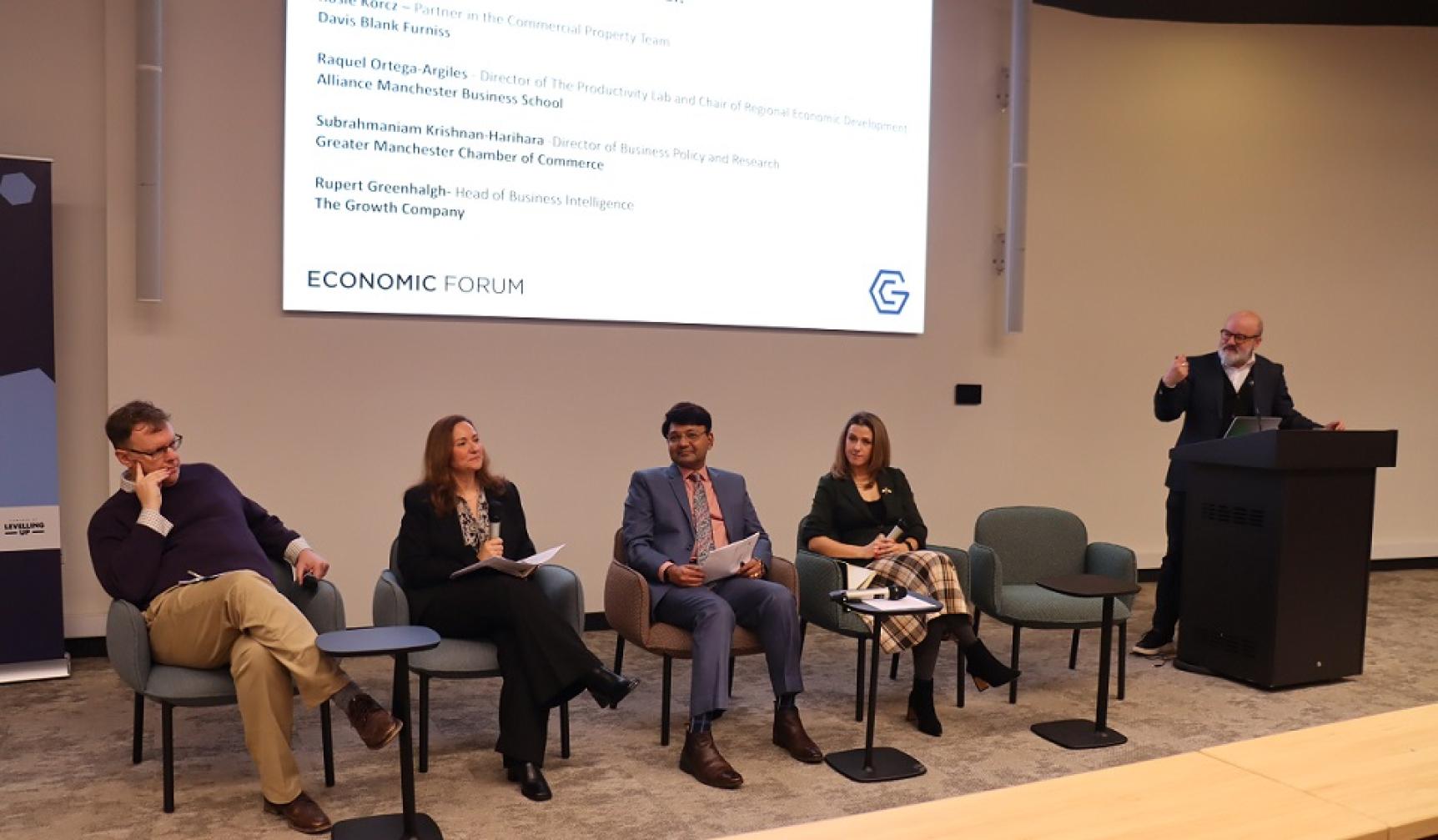
After giving their presentations, Subrahmaniam and Rupert took part in a panel discussion with Rosie Korcz, Partner in the Commercial Property Team at Davis Blank Furniss, and Raquel Ortega-Argiles, Director of The Productivity Lab and Chair of Regional Economic Development at Alliance Manchester Business School (pictured).