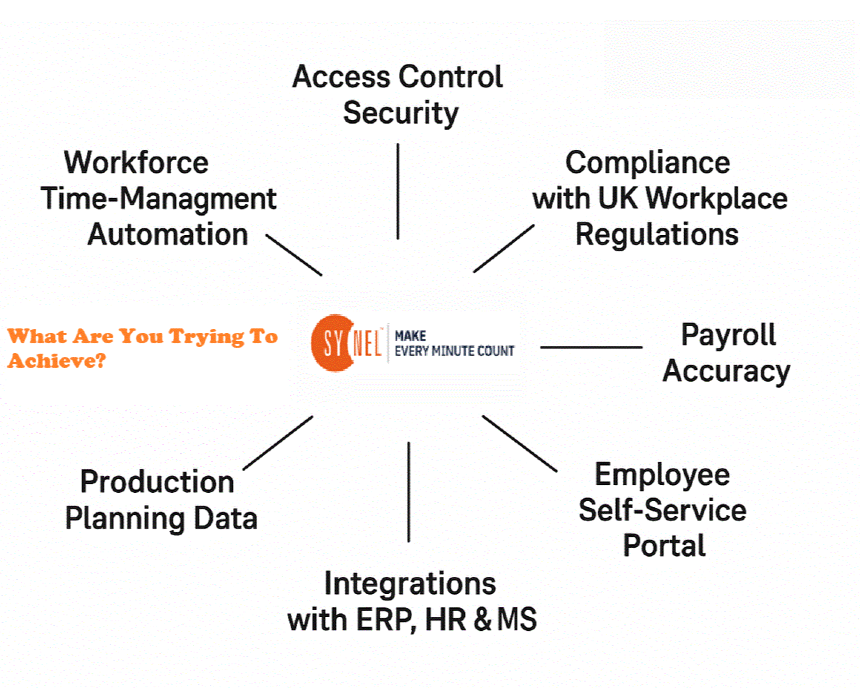
Key challenges UK manufacturing firms face with Access Control and Workforce Management

Current trends in Manufacturing suggest that processes (including workforce tracking, access control, administration) are inefficient. The following details some of the key challenges along with associated impact.
1. Integrating Access Control with Legacy Systems
Challenge: Many manufacturing sites still rely on outdated physical access systems (e.g., keycards, turnstiles, paper logs) that don’t integrate easily with modern digital systems or HR platforms.
Impact: Inefficiencies in monitoring who is on-site, potential security gaps, and difficulties in scaling or upgrading systems across multiple sites.
Example: Difficulty linking older door access systems to newer biometric or cloud-based time-tracking software.
2. Managing a Diverse and Dynamic Workforce
Challenge: UK manufacturing often uses a mix of full-time staff, contractors, and agency workers, with fluctuating shifts.
Impact: Complexities in granting/revoking site access quickly and ensuring accurate timekeeping for payroll, compliance, and safety.
Example: Temporary workers’ credentials might remain active after contract end, creating security and compliance risks.
3. Compliance with Health, Safety, and Security Regulations
Challenge: Compliance with UK laws such as the Health and Safety at Work Act 1974, GDPR, and sector-specific standards (e.g., ISO 45001 for occupational health and safety).
Impact: Firms must maintain auditable records of who is on-site and when, especially during incidents or emergencies.
Example: Inadequate visitor tracking can breach safety audit requirements or expose the firm to liability after an incident.
4. Data Privacy and Cybersecurity Risks
Challenge: Increasing adoption of biometric systems (facial recognition, fingerprint scanners) introduces sensitive personal data management issues.
Impact: Non-compliance with GDPR can lead to fines; security breaches can erode trust.
Example: Inadequate encryption or consent management for biometric data could lead to legal and reputational damage.
5. Accurate Time and Attendance Tracking
Challenge: Manual or fragmented systems lead to errors in attendance, overtime, and productivity tracking.
Impact: Payroll inaccuracies, disputes, and reduced productivity insights.
Example: Workers clocking in/out for colleagues (“buddy punching”) remains a persistent issue.
6. Balancing Automation with Workforce Trust
Challenge: Introducing advanced monitoring tools (e.g., AI-based attendance or behaviour analytics) can trigger employee resistance or union pushback.
Impact: Lower morale and potential conflicts if staff perceive surveillance as intrusive.
Example: Use of CCTV-linked analytics may raise privacy and ethical concerns.
7. Multi-Site and Remote Management
Challenge: Larger manufacturers operate across multiple UK or international sites, often with varied systems.
Impact: Centralised oversight of access rights, attendance data, and compliance becomes difficult.
Example: A company with plants in Birmingham and Glasgow may struggle to unify access data into a single dashboard.
8. Cost and Resource Constraints
Challenge: Implementing modern access control (cloud-based, biometric, integrated) requires upfront investment and staff training.
Impact: SMEs, in particular, face budgetary pressures when balancing security and operational efficiency.
Example: Upgrading to a fully integrated access and workforce management solution may not show immediate ROI.
9. Real-Time Visibility and Incident Response
Challenge: Lack of real-time data on personnel movement can hinder emergency response and productivity optimisation.
Impact: Delays in evacuation, accountability gaps during incidents, and inefficient scheduling.
Example: Inability to instantly verify who is on-site during a fire drill or lockdown.
10. Leveraging Workforce Analytics
Challenge: Many firms collect attendance data but don’t use it effectively for performance or process improvements.
Impact: Missed opportunities to optimise worker & time allocation, reduce downtime, or forecast staffing needs.
Example: Not analysing patterns of absenteeism tied to production bottlenecks.
If some of the above challenges resonate in your business you may be interested in hearing what we have been able to do to address the above for our customers.
I would be delighted to share some insight and explore if a solution from Synel could help to benefit your organisation for Access Control and/or Workforce Management. Also as Chamber members any initial review is provided for free and without any obligation.